Lone Working: Danish Rules and Requirements
A practical guide for employers – legal requirements, risk assessment and a concrete checklist.

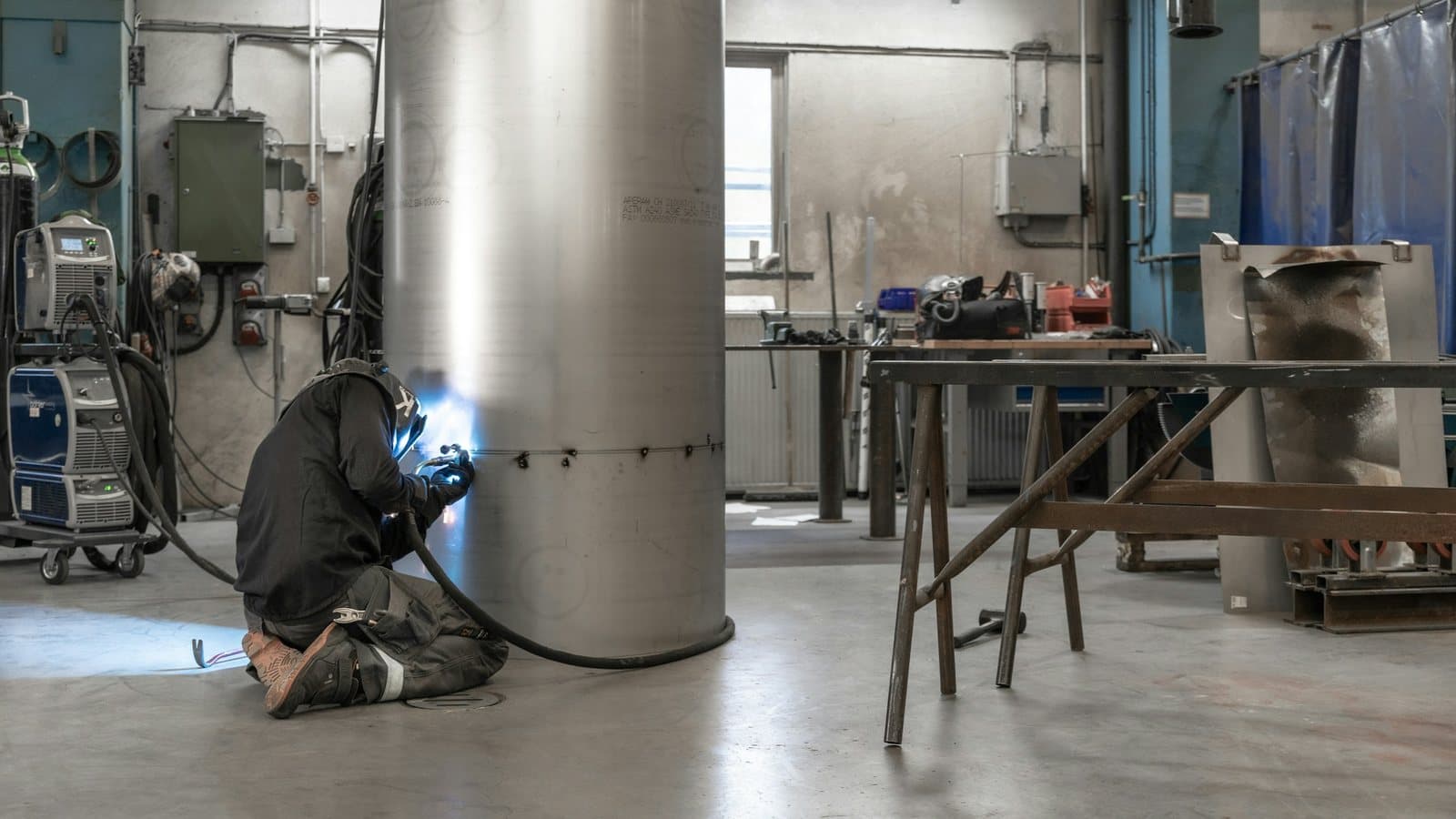
Neither the Danish Working Environment Act nor the Executive Order on the Performance of Work names a particular alarm. The requirement is that if lone working can involve a particular danger for the person concerned, you must organise the work so that the danger is countered – and if it cannot be countered, the employee must not work alone. This guide sets out the rules in force, the three questions that decide whether your solution holds up in practice, and a checklist for the workplace assessment.
This guide is written for employers, health and safety representatives and managers in industry, warehousing, retail, healthcare and care work in Denmark. Every legal reference has been checked against the text in force in August 2026 and links directly to the source.
What is lone working according to the Danish Working Environment Authority?
According to the Danish Working Environment Authority (Arbejdstilsynet), lone working means that the employee cannot be seen or heard by others from the company without technical aids – such as alarms, telephones or visual monitoring equipment – while the work is being carried out. The definition is therefore about contact, not about distance.[3]
That is an important distinction. A technician servicing a machine alone in a production hall is a lone worker under the Authority's definition, even though there are colleagues elsewhere in the building. The same goes for a home-care worker on a visit to a client, a warehouse employee on a night shift and a retail employee during a closing shift.
Not all lone working carries the same risk profile. An office employee alone on a Sunday afternoon faces a very different risk from someone working alone with heavy machinery or making home visits to clients with a history of conflict. The rules distinguish – and so should your risk assessment.
Which rules apply to lone working?
Lone working is not prohibited, but it is regulated. Section 15 of the Danish Working Environment Act requires the employer to ensure that working conditions are fully safe and healthy. Section 11 of the Executive Order on the Performance of Work makes the requirement concrete: if the work process involves a particular danger for the person working alone, the work must be organised so that the danger is countered.[1][2]
"If the danger cannot be countered, the employee must not work alone." – Section 11 of Executive Order no. 1839 of 14 December 2023 on the Performance of Work.
In practice, the employer's responsibility rests on four duties:
- Risk assessment in the APV: The employer must ensure that a workplace assessment of the working environment is carried out (Section 15 a of the Working Environment Act). Lone working is a working environment factor like any other, so it belongs in the APV.
- Organisation of the work: The work must be planned so that any particular danger arising from the lone working is countered – otherwise it must not be carried out alone (Section 11 of the Executive Order).
- Instruction: Employees must receive the necessary training and instruction to carry out the work safely (Section 17(2) of the Working Environment Act), and only employees with appropriate instruction may have access to areas with a particular danger (Section 11(2) of the Executive Order).
- Effective supervision: The employer must ensure effective supervision that the work is in fact carried out in a safe and healthy manner (Section 16 of the Working Environment Act).
What applies when there is a risk of violence and threats?
If employees work alone, the manager must assess whether this entails a particular risk of violence. The Working Environment Authority points to two ways that particular risk can show itself: that there is a risk of more incidents of violence when the employee is alone – or that the employee is more seriously injured in the individual incident, because sufficiently fast and effective help cannot be obtained.[3]
The employer must plan the work so that the danger is countered – for example with guidelines for which situations call for more than one person on a task, which tasks must not be carried out alone, and how employees should react at the first sign of violence. If you cannot counter the particular risk of violence, the employee must not work alone. Young people under 18 may only carry out work involving a particular risk of violence together with a person over 18.[3]
When is an alarm enough?
The law does not name any specific technology. An alarm can form part of the solution precisely because the Working Environment Authority's own definition counts alarms as a technical aid that can replace being seen and heard. Whether your alarm is enough depends on whether it actually counters the danger in the specific situation.[2][3] You must be able to document that assessment in the APV.[1][4]
Three practical questions usually decide whether an alarm holds up in reality. They are not in the law – they are our practical translation of the requirement that the danger must be countered:
- Can it be activated? Also by an employee who has been injured, has only one hand free, or is facing a threatening person and cannot look at a screen.
- Does it reach someone who can respond? At night, at weekends and during holiday periods too – not just a rota on paper.
- Does help arrive quickly enough? The recipient must be close enough that the response time makes a difference in the exact situation you have assessed.
That is one reason a mobile phone in a pocket is rarely enough on its own: it sits in a jacket at the other end of the hall, it usually takes two hands and a glance at the screen, and it is hard to use discreetly. A dedicated safety button worn on the body and triggered without looking at it addresses the first two questions directly. The third – whether help arrives quickly enough – is not something any device settles on its own: it depends on who you set as recipients and where they are.
What goes into the APV – and what does the Working Environment Authority look for?
The employer must ensure that a workplace assessment of the working environment is carried out. If a problem cannot be solved immediately, it must be described in a written action plan stating when and how you will solve it, and who is responsible. The action plan must be available in the company so that employees, management and the Working Environment Authority can all see it.[1][4]
The APV process must be carried out when there are changes to the work, the working methods or the work processes that may affect the working environment – and as a minimum you must cover all of the company's working environment factors every three years. So new machinery, changed shift patterns or fewer people on the night shift are all reasons to take lone working up again.[4]
How can a safety button support the requirements?
A safety button does not solve the task on its own – but it can be the technical part of the "fast and effective help" the Working Environment Authority asks employees to have access to, when the risk assessment shows that the employee must be able to call someone.[3] With Linucare, the employee activates the alarm on the button itself, and the alarm goes directly to the colleagues you have chosen, with live GPS so they can see exactly where to go.
You decide who receives the alarm. It can go to the nearest colleagues, to an on-call responder or to a whole team – and the app shows who has seen the alarm and accepted it. With priority alarms, if the first recipient does not answer within 30 seconds the alarm is automatically forwarded to the next. Recipients get a loud alarm tone even when the phone is on silent or "do not disturb", and group calls and chat can be started while help is on the way.
- The safety button (Bluetooth): Worn with a wristband, neck strap or metal clip. Activated by two presses as standard, and you can change how the button is activated in the app. Replaceable CR2032 battery with up to 3 years of life, and a range of up to 50 metres to the phone.
- Linucare Hub (business): Picks up the Bluetooth signal from the buttons so the alarm works without a phone nearby – with a range of up to 200 metres. It can also run as a backup that always catches the button's signal – extra safety, for example where there is no fixed phone present.
- The GPS alarm button (business): A standalone unit with its own SIM card that works anywhere with mobile coverage – without a smartphone. It has a speaker and microphone for two-way voice, automatic fall detection, IP67 waterproofing and 96 hours of battery life.
At Hamlet Factory, night workers carry the GPS button in their own setup, where the alarm first goes to the factory's own control centre and then escalates. And on the Grundfos production floor, the solution gives employees a direct line to their colleagues. Read how Grundfos uses Linucare for employee safety, or see Linucare's personnel safety solution.
What should you check in your APV about lone working?
Six questions to work through when you take lone working up in the APV: whether you have mapped the lone working, whether the risk is assessed for each role, whether the alarm can be activated, whether it reaches a recipient, whether help can arrive in time – and whether all of it is written down. They are our practical checklist, not a requirement from the Working Environment Authority.
- 1. Identified: Are all situations of lone working – including outside normal hours – mapped?
- 2. Assessed: Are risks (violence, accidents, sudden illness) described specifically for each role?
- 3. Activation: Can the employee trigger an alarm with one hand, discreetly, and without having to search for a device?
- 4. Reception: Is there always a recipient available who can react – including nights and weekends?
- 5. Response time: Can help actually arrive within a timeframe where it makes a difference?
- 6. Documentation: Are the assessment, the solution and the instruction in the written action plan of the APV – and is it available during an inspection?
Frequently asked questions about lone working
What counts as lone working?
The Danish Working Environment Authority (Arbejdstilsynet) defines lone working as work where the employee cannot be seen or heard by others from the company without technical aids such as alarms, telephones or visual monitoring equipment. The definition is about contact, not distance: a technician in a production hall can be a lone worker under the definition even though colleagues are elsewhere in the building. Conversely, an employee is not a lone worker simply because she sits in an office by herself with colleagues within sight and earshot.
Is it legal to let an employee work alone?
Yes, lone working is legal as a starting point. But if the work process involves a particular danger for the person working alone, Section 11 of the Danish Executive Order on the Performance of Work requires the work to be organised so that the danger is countered. If the danger cannot be countered, the employee must not work alone. It is the employer who is responsible for that assessment, and for ensuring that working conditions are fully safe and healthy overall, under Section 15 of the Danish Working Environment Act.
Does lone working have to be part of the APV?
Yes. The employer must ensure that a workplace assessment (APV) of the working environment is carried out, and lone working is a working environment factor like any other. If a problem cannot be solved immediately, it must be described in a written action plan stating when and how you will solve it, and who is responsible. The action plan must be available in the company so that employees, management and the Working Environment Authority can all see it. The APV process must be repeated when the work changes, and at least every three years.
Is a mobile phone enough as an emergency call for lone working?
The law does not name any specific technology, so it depends on whether the solution actually counters the danger in the specific situation. A mobile phone is often the weakest solution in practice: it sits in a jacket at the other end of the hall, it usually takes two hands and a glance at the screen, and it is hard to use discreetly in front of a threatening person. Whichever solution you choose, you must be able to document the assessment behind it in the APV.
What should an alarm for lone working be able to do?
Neither the Working Environment Act nor the Executive Order on the Performance of Work names a specific technology or set of features, but three practical questions usually decide whether an alarm holds up in reality. Can it be activated by an employee who has been injured, is under pressure or has only one hand free? Does the alarm reach someone who can actually respond – at night and at weekends too? And can help arrive quickly enough to make a difference? The questions are not in the law; they are a practical way to test whether the danger has really been countered. If you cannot answer yes to all three, look at the solution again.
How do we document lone working to the Working Environment Authority?
The documentation the rules actually require is the written action plan in the APV, which must be available in writing so that employees, management and the Working Environment Authority can all see it. In practice it also helps if it covers the whole picture: which lone-working situations you have mapped, how you assessed the risk in each of them, which solution you chose, and how employees are instructed in using it. Remember to revisit the assessment when the work changes – for example with new machinery, new shift patterns or fewer people on the night shift.
[1] The Danish Working Environment Act, Sections 15, 15 a, 16 and 17 – Consolidated Act no. 1108 of 15 September 2025, Retsinformation, retsinformation.dk
[2] Executive Order on the Performance of Work, Section 11 on lone working – Executive Order no. 1839 of 14 December 2023, Retsinformation, retsinformation.dk
[3] The Danish Working Environment Authority, guidance on working with people who may react violently, the section "Vigtigt om alenearbejde", at.dk
[4] The Danish Working Environment Authority, Requirements for the APV, at.dk
Quotations from Danish legislation and from the Danish Working Environment Authority are translated from the Danish original; the Danish text is the authoritative one. This guide is general information, not legal advice.
Book a 20-minute demo
Want to see how a dedicated safety button can support your work with the Danish Working Environment Authority's requirements – and how you choose who receives the alarm? We review your specific situation and demonstrate the button in practice.